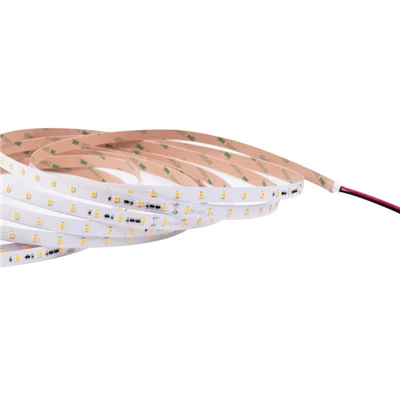
In modern architectural lighting, LED strips are widely used to create neat and continuous light lines. However, many designers and installers encounter common problems after installation. Obvious light dots and uneven light will ruin the seamless lighting effect.
This situation greatly affects the presentation of high-end interior projects. How can we achieve true dotless LED linear lighting? The effect depends not only on LED strips. It requires reasonable matching of led bead density, light diffusion and aluminum profile structure.

Why LED Strip Lights Show Visible Dots

Dotting occurs when light from individual LED chips with 120° beam angle does not fully blend before reaching the diffuser surface. This is mainly caused by insufficient optical mixing distance in shallow profiles or low-density LED strips.
LED density
Aluminum profile depth
Diffuser type
Among these, profile depth and LED density are the most critical factors controlling visual uniformity.
Three Critical Selection Criteria
1. LED Strip Density

More LEDs per meter means smaller spacing between chips, which naturally increases overlap and therefore reduces the profile depth required.
Entry-level (60-90 LEDs/m): Hotspots are obvious; very deep profiles (≥18-25mm) are required. Not suitable for exposed locations.
Mainstream (120-168 LEDs/m): The most common range used for home use. Medium depth pairs (13-18mm).
High-density (180-240 LEDs/m): It greatly reduces the required depth to allow for installation in 5–10mm slim channels
Pro tip: COB strips provide a continuous light-emitting surface, which reduces visible dotting significantly more than SMD strips.
3. Aluminum Profile Depth
Internal cavity depth is the most critical yet most overlooked spec. Many buyers focus on the outer width and ignore the internal depth; that's the biggest selection mistake.
5-7mm height: Only suitable for 240+ LEDs/m ultra-dense or COB strips;
8-10mm height: Works with 180-240 LEDs/m strips;
13-18mm height: The sweet spot for 120-168 LEDs/m, most recommended for home use;
25mm+ height: Required for 60-90 LEDs/m low-density strips, or when you demand absolute uniformity.
4. Diffuser Type

|
Type |
Transmission |
Effect |
|
Clear |
> 90% |
Poor, only for COB or ≥240D |
|
Frosted |
80-85% |
Good, most recommended |
|
Opal |
70-75% |
Excellent, for low mounting |
|
Black |
60-65% |
Excellent, hidden-source design |
For everyday home use, frosted PC is the top choice, as it offers the best balance between brightness and uniformity.
Final Design Rule:
A dot-free LED linear lighting system is achieved by balancing LED density, aluminum profile depth, and diffuser type. Proper matching is more important than any single specification.

LED Density vs Aluminum Profile Height Compatibility
The difficulty of eliminating hotspots varies significantly with strip density. Denser strips require less mixing distance; sparser strips need a much deeper cavity to allow sufficient light blending.
The following compatibility matrix summarizes real-world installation results across different LED densities and aluminum profile depths.(把这个表组成上下左右拉动的)
|
Channel Internal Height (H) |
60LEDs/m |
90LEDs/m |
120LEDs/m |
128LEDs/m |
144LEDs/m |
160LEDs/m |
168LEDs/m |
180LEDs/m |
200LEDs/m |
240LEDs/m |
|
5mm |
✕Hotspots |
✕Hotspots |
✕Hotspots |
✕Hotspots |
✕Hotspots |
✕Hotspots |
✕Hotspots |
✕Hotspots |
✕Hotspots |
✓ Dotless |
|
7mm |
✕Hotspots |
✕Hotspots |
✕Hotspots |
✕Hotspots |
✕Hotspots |
✕Hotspots |
✕Hotspots |
✕Hotspots |
✓ Dotless |
✓ Dotless |
|
8mm |
✕Hotspots |
✕Hotspots |
✕Hotspots |
✕Hotspots |
✕Hotspots |
✓ Dotless |
✓ Dotless |
✓ Dotless |
✓ Dotless |
✓ Dotless |
|
9mm |
✕Hotspots |
✕Hotspots |
✕Hotspots |
✕Hotspots |
✓ Dotless |
✓ Dotless |
✓ Dotless |
✓ Dotless |
✓ Dotless |
✓ Dotless |
|
10mm |
✕Hotspots |
✕Hotspots |
✓ Dotless |
✓ Dotless |
✓ Dotless |
✓ Dotless |
✓ Dotless |
✓ Dotless |
✓ Dotless |
✓ Dotless |
|
13mm |
✕Hotspots |
✓ Dotless |
✓ Dotless |
✓ Dotless |
✓ Dotless |
✓ Dotless |
✓ Dotless |
✓ Dotless |
✓ Dotless |
✓ Dotless |
|
17-25mm |
✓ Dotless |
✓ Dotless |
✓ Dotless |
✓ Dotless |
✓ Dotless |
✓ Dotless |
✓ Dotless |
✓ Dotless |
✓ Dotless |
✓ Dotless |
When space and budget allow, opt for a deeper profile with a moderate-density strip rather than an ultra-dense strip with a shallow channel. For example, a 17mm profile paired with a 120 LEDs/m strip often delivers better value and softer light than a 5mm profile with a 240 LEDs/m strip. Plus, deeper profiles provide superior heat dissipation to extend the LED lifespan.
Shapes of Aluminum Profiles

Aluminium profiles come in many different cross-sectional shapes. Each of them is suitable for various installation situations and light effects. Some common shapes are:
U-Shaped: Most versatile for surface-mounting on ceilings, display cases or any flat plane.
V-Shaped (Corner): Intended for corners where two surfaces meet. It's perfect for cove lighting or wall washing and projects light at an angle.
T-Shaped (Recessed): Flanges on either side. Cut grooves in plasterboard or wood and fit flush. This allows the light source to be flush with the surface and gives a seamless look.
Selection Guide: The right shape depends on your installation location (flat surface, corner, or recessed) and your desired visual effect.
How to Use Aluminum Profiles
For installation, cut the profile to length, secure it to a flat surface with screws or clips (at ≤40cm intervals), press the strip along the centerline of the channel, slide the diffuser horizontally from one end into the grooves, then power on to test before installing the end caps.

Functions of Aluminum Profiles
1. Heat Dissipation

LED strips will produce heat while working. Excessive heat will speed up light decay, lower brightness and shorten service life. Aluminum features excellent thermal conductivity. It transfers heat rapidly and keeps lights working steadily.
2. Structural Protection

Aluminum profiles provide robust protection for LED strips to prevent damage from bending or extrusion while blocking dust and accidental contact.
3. Optics optimisation

They can diffuse point light sources well and eliminate the visible dots of light. They smooth the light to achieve a seamless linear lighting effect.
4. Easy Installation & Nice Appearance

Aluminum profiles simplify the installation of LED strips. They support recessed, surface and suspended mounting methods. They improve overall decorative effect and help create a clean, modern ambient lighting effect in residential spaces.
In conclusion
dotless linear lighting depends on a balanced system of LED density, profile depth, and diffuser type. Proper matching of these elements ensures smooth, uniform light without visible hotspots, which delivers a clean and high-end lighting effect.