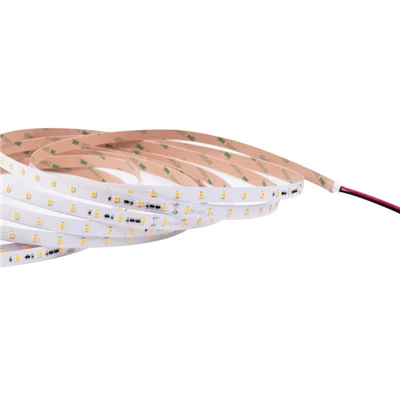
As an important innovation in the field of modern lighting, LED light strips are widely used in commercial display, home decoration and industrial lighting due to their energy-saving, flexible and diversified characteristics. Understanding its internal structure not only helps consumers choose suitable products, but also provides technical references for industry practitioners.
The core components of LED light strips include LED lamp beads, circuit boards, driver power supplies and shell packaging. LED lamp beads are key components for luminescence, usually packaged with SMD (surface mount device) technology. Common models include 2835, 5050, etc. Different models determine the brightness, color temperature and energy consumption performance of the light strip. High-quality LED lamp beads have higher light efficiency and longer service life, which is the basis for ensuring the stable performance of the light strip.
The circuit board is the supporting structure of the LED light strip, usually made of flexible FPC (flexible printed circuit board) or rigid PCB (printed circuit board). The FPC circuit board enables the light strip to bend and fit various complex shapes, suitable for decorative lighting; while the PCB circuit board is more suitable for industrial scenes that require high stability. The conductive performance and heat dissipation design of the circuit board directly affect the brightness and life of the light strip.
The driver is the "heart" of the LED light strip, responsible for converting the input voltage into a constant current suitable for LED operation. Common driving methods include constant current drive and constant voltage drive. The former can control the current more accurately and reduce light decay, while the latter is more suitable for long-distance power supply. High-quality driver can effectively reduce flicker and heat accumulation, and improve the safety and reliability of the light strip.
Shell packaging is a key layer to protect internal components, usually made of PVC or silicone. PVC packaging is economical and practical, suitable for indoor environments; silicone packaging has better waterproof and high temperature resistance, suitable for outdoor or humid environments. Some high-end light strips also use double packaging technology to further improve durability.
With the advancement of technology, the structural design of LED light strips is moving towards a lighter, thinner and more efficient direction. In the future, the integration of intelligent control and variable color temperature technology will further expand its application scenarios and bring more possibilities to the global lighting market.